

Do you know that communication is 55% nonverbal, 38% vocal and only 7% words (statistic from Albert Mehrabian, a researcher of body language).
Nonverbal communication, in other simple words, is your body language. Body language includes posture, eye contact, facial expressions and gestures, movements. The interesting thing about body language is that it often displays in the unconscious (mindlessly). That is why body language cannot lie. If you really observe the one you are talking with, you can see far more than his/her words.
Do you have an experience of seeing someone look so tired but they tried to say I am fine? It is not too difficult to notice their body language: slower and quieter than usual, red eyes and the eyes going downward, suddenly clumsy. Hence, many body language signals, which are easy to see, can imply negative states, such as boredom, disinterest, anxiety, uncertainty.
However, do not jump to conclusions too soon just based on a single movement, gesture,or facial expressions. Kuhnke advises “body language is best interpreted in clusters and in context.” (cf.1)
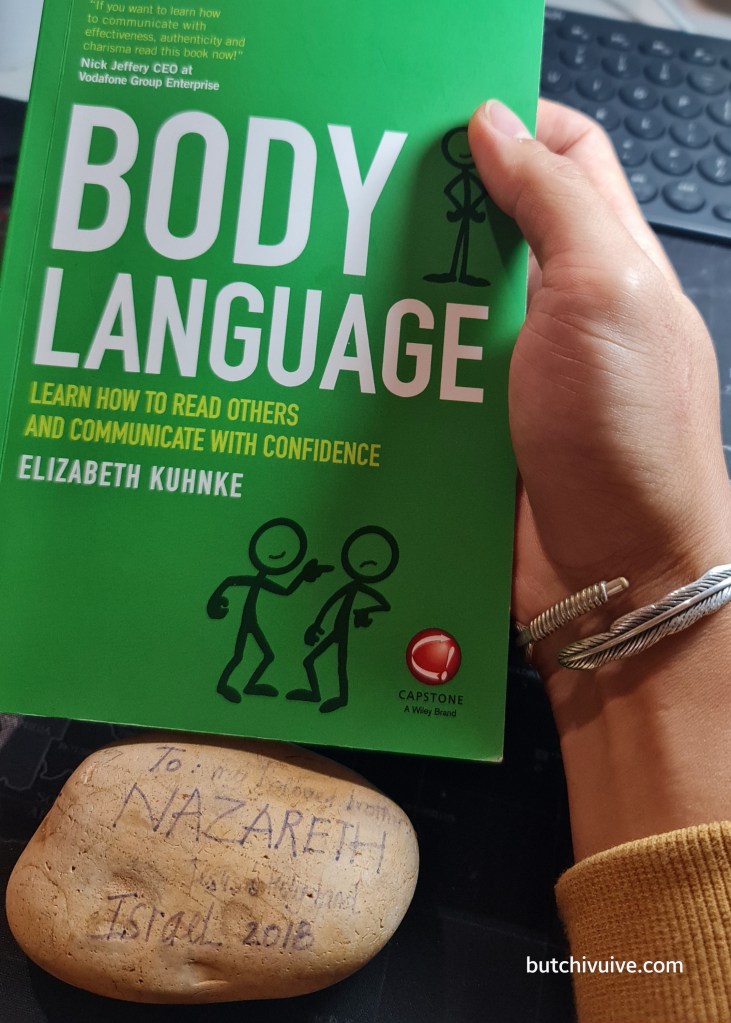
Now, I just want to focus on one specific topic: Passive aggressive behaviour (Cf.2)
Passive aggressive behaviours:
- FACIAL EXPRESSIONS:
False smiles.
Pursed lips.
Sneering.
Raised eyebrows in fake surprise.
Widened eyes of innocence.
Avoiding eye-contact.
Laughing while angry.
Smiling and winking when annoyed.
Sulking.
- GESTURES
Checking phone
Looking away when others are talking.
Tense muscles
Finger pointing.
- VOCAL PATTERNS
Sarcastic
Cold
Mumbling
Making wistful statements (I wish I could…)
Dropping hints
Small putdowns, insults and back-handed compliments.
One-word answers.
Asking thread-based questions (why would you think that’s a good idea?)
Saying expressions like “I’m fine” through gritted teeth.
WHAT SHOULD YOU CAN REACT TO THE AGGRESSIVE BEHAVIOUR?
After recognising their negative behaviours, give yourself silent messages like “He/she is being passive aggressive and I WILL NOT participate in his routine! Or “I will not respond by yelling or being sarcastic because doing so will escalate the conflict.”
However, you need to point out the big elephant in the room. They tend to guard themselves by denying their anger. Hence, you can say in a non-judgemental way, such as “it seems to me that you’re angry at me by bringing this up.” Very commonly, they will deny it. Then, you can say: “OK, I just wanted to share that thought with you.”
Do not argue or point out the denial!
You did a great job because by pointing out or being aware of his/her covert anger, you have sent a powerful message that you’re aware of the game being played and that things need to change.
Let’s try to observe, practice and see the result!
Have a nice weekend!
With love,
Butchivuive (Happy pencil)
Footnote 1 and 2: Elizabeth Kuhnke, Body Language: Learn How to Read Others and Communicate with Confidence, (Hoboken: Capstone, 2016), 18, 69-72.
 Little-pencil