

In the early 19th century, a small act of kindness sparked a revolution of change in the world of education. In 1827, a young woman named Maria Montessori, inspired by her work with children in Rome, began making small adjustments in her teaching methods. She observed that children learned best when allowed to explore and interact with their environment, rather than simply memorizing facts. Instead of using traditional methods, she introduced hands-on materials that allowed students to engage with concepts directly.
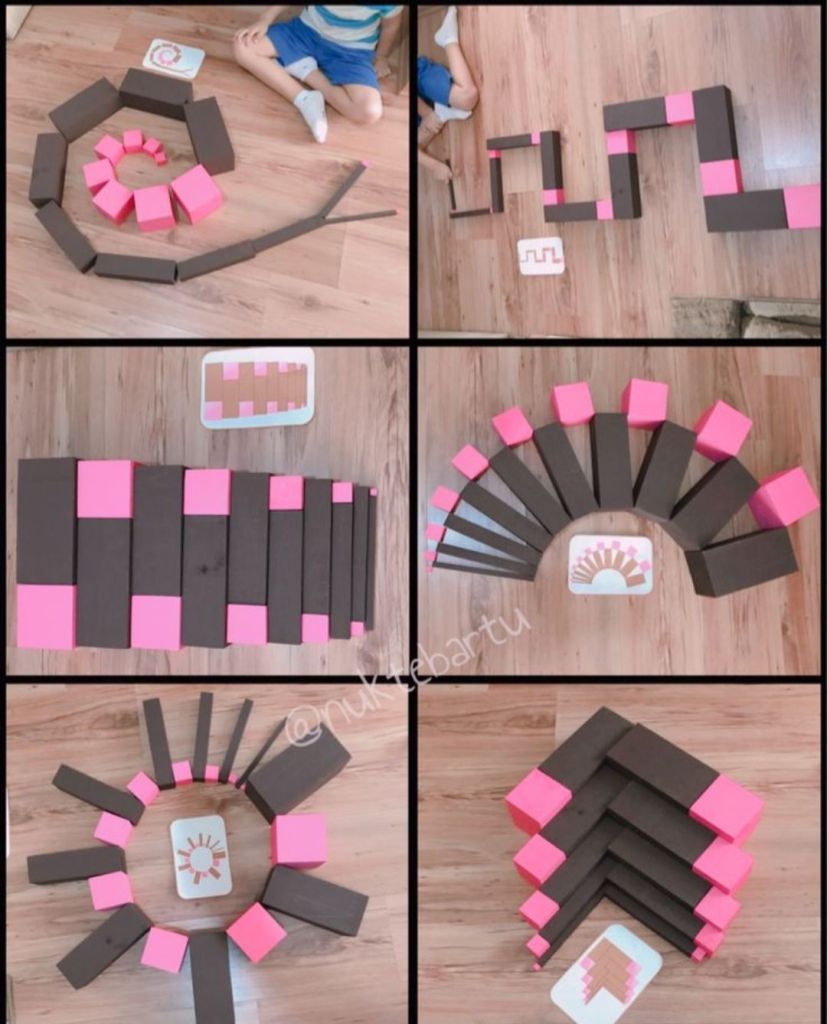
One of the most famous hands-on materials developed by Maria Montessori is the “Montessori Pink Tower”. This material consists of ten pink wooden cubes, ranging in size from 1 cm³ to 10 cm³. The cubes are arranged in a specific order, from smallest to largest, and children are encouraged to stack them in a precise sequence.

The Pink Tower serves multiple purposes. It helps young children develop their “visual discrimination” of size and “hand-eye coordination” as they carefully handle and arrange the cubes. It also introduces basic mathematical concepts, such as “proportions” and “gradual progression” in size. As children manipulate the cubes, they internalize these concepts in a tactile way, making learning more concrete and intuitive than through abstract memorization.
This material is an example of how Montessori’s hands-on approach allows children to learn by doing, making abstract concepts more accessible and fostering independent exploration. Through such materials, Montessori’s method encourages both cognitive and physical development, laying a foundation for deeper learning.
Her approach was simple but profound. She started with a modest group of children from disadvantaged backgrounds in Rome, showing that with the right tools and environment, even the most overlooked children could thrive. As a result, Montessori’s method proved remarkably effective. Over time, word spread, and her educational philosophy gained global recognition. Today, over 20,000 Montessori schools exist around the world, impacting millions of children.
What started as a small shift in how one teacher approached her classroom ultimately transformed global education. This story highlights how a small, thoughtful change can ripple outward and create lasting, large-scale impact, proving that even the smallest efforts can make a significant difference in the world.
Let’s make a small effort everyday!
With love,
Little-pencil
 Little-pencil