

“As soon as Judas had taken the piece of bread he went out. Night had fallen.” (John 13:30)
Tuesday of the Holy Week opens another great symbolic details in the Gospel of John: Judas went into the Night. Let us put our attention into the symbol of spiritual Darkness and Existential and Theological Depth in Johannine theology.
Symbol of Spiritual Darkness
In Johannine theology, light and darkness are more than natural phenomena — they are symbols of good and evil, faith and unbelief, life and death. From the very beginning of his Gospel, John sets this dualism in motion:
“The light shines in the darkness, and the darkness has not overcome it.” (John 1:5)
“But people loved darkness instead of light because their deeds were evil.” (John 3:19)
Thus, when John writes “And it was night,” he is not merely telling us the sun had set. He is declaring that Judas has stepped into darkness, both physically and spiritually. He is describing the hour when evil begins to take its full course, when betrayal replaces friendship, and death prepares to confront the Lord of life.
Existential and Theological Depth:
This moment carries a deep existential weight. Judas chooses night — he chooses to walk away from the Light of the World (John 8:12). His departure is not just from a room, but from relationship, from truth, from grace. And in doing so, he becomes a tragic figure of what it means to abandon Christ and enter into the cold absence of his presence. John’s short sentence — “And it was night” — becomes a poetic judgment, a metaphysical turning point in the Gospel. Jesus is about to begin his Passion, the disciples are about to scatter, and the powers of darkness are about to unleash their fury.
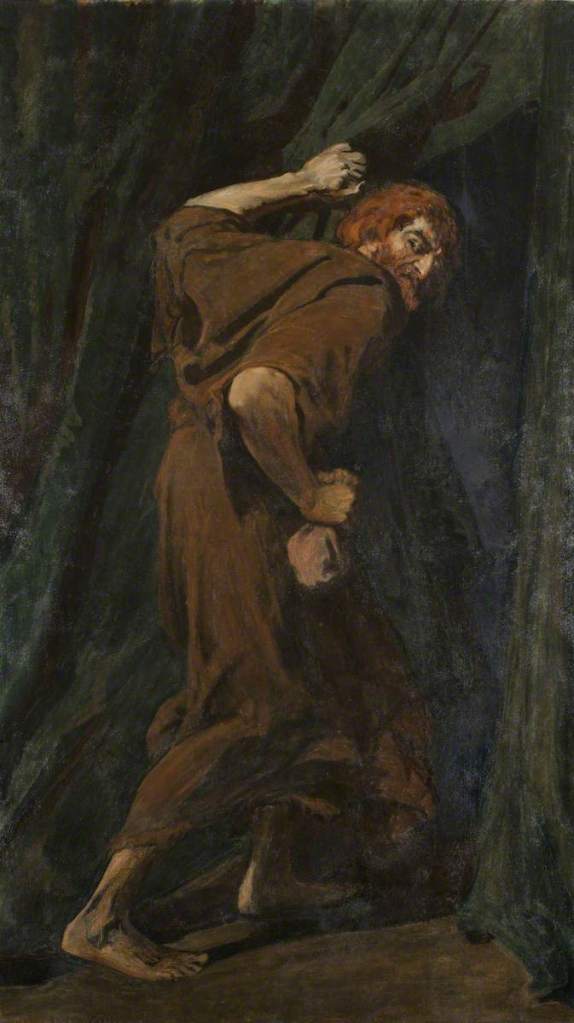
Christopher Williams (1873–1934)
Aberystwyth University School of Art Museum and Galleries
My friends, this Gospel confronts us with a question:
Where do we stand when night falls?
When confusion, fear, sin, or sorrow darkens our path, where is our heart?
Sometimes we are like Judas — tempted to step away from the light, from trust, from Christ.
Sometimes we are like Peter — full of good intentions, but too weak to follow through.
And sometimes, by grace, we are like Mary — staying close, even in the shadows of Calvary.
But the good news is this: Jesus does not stop loving, even when we walk into the night.
He follows us. He dies for us.
And from the deepest darkness, he will rise with the morning light.
So tonight, as we sit in the quiet of Holy Week, as the shadows of the Passion gather, let us not be afraid of the night. Let us walk with Jesus — through betrayal, through suffering, through the cross — with hearts full of love and hope.
Because after every “night” in John’s Gospel, the Light shines again.
With love and prayers,
Little-pencil
 Little-pencil