

“God, I trust you… but why did this happen?”
“I believe… but I don’t understand why you didn’t act.”
Do these sentences seem to be familiar with us? Psychologically, this is very human, and we often say the same. This attitude of reproach, a gentle of blame, disappointment or quiet complaint opens our Lenten reflection this year:
We contemplate Mary in Gospel of John (11:32–35) as a mirror for our Lenten journey. When she falls at the feet of Jesus Christ and says, “Lord, if you had been here, my brother would not have died,” her words carry a deep ambiguity: they are both a confession of faith and a quiet reproach. Psychologically, this is the tension of the human heart, what we might call ambivalent trust. We believe, yet we also resist; we surrender, yet we still attempt to control.
Mary’s statement reveals a faith that is real but not yet complete. She believes in Jesus’ power, but only within the limits of her own expectations, He could have prevented death, but she does not yet imagine that He can conquer it. In this way, her grief narrows her vision. This is profoundly human. In moments of suffering, our perception contracts; we interpret God’s presence through the lens of immediate outcomes. When things go well, we say, “God is with me.” When they fall apart, we quietly wonder, “Where was He?”
Yet the striking response of Jesus is not correction, but compassion: “Jesus wept.” In that moment, God does not argue theology; He enters into human pain. This reveals a crucial truth: divine love is not proven by the absence of suffering, but by God’s presence within it. The tears of Christ affirm that faith is not about having all answers, but about remaining in relationship, even when confused, wounded, or disappointed.
For believers today, the practical lesson is both simple and demanding: purify our faith from conditions. Instead of saying, “I trust God if things go my way,” we are invited to say, “I trust God even when I do not understand.” This requires a daily exercise of surrender. Concretely, one might practice this by ending each day with a brief examen: recalling a difficult moment and consciously entrusting it to God, saying, “Lord, you were there, even if I did not see you.”
Lent, then, becomes a journey from conditional faith to steadfast trust. Like Mary, we may begin with questions and hidden reproaches. But if we remain close to Christ, we will discover that His presence is deeper than our expectations and that even in silence, He is already at work, preparing a resurrection we cannot yet imagine.
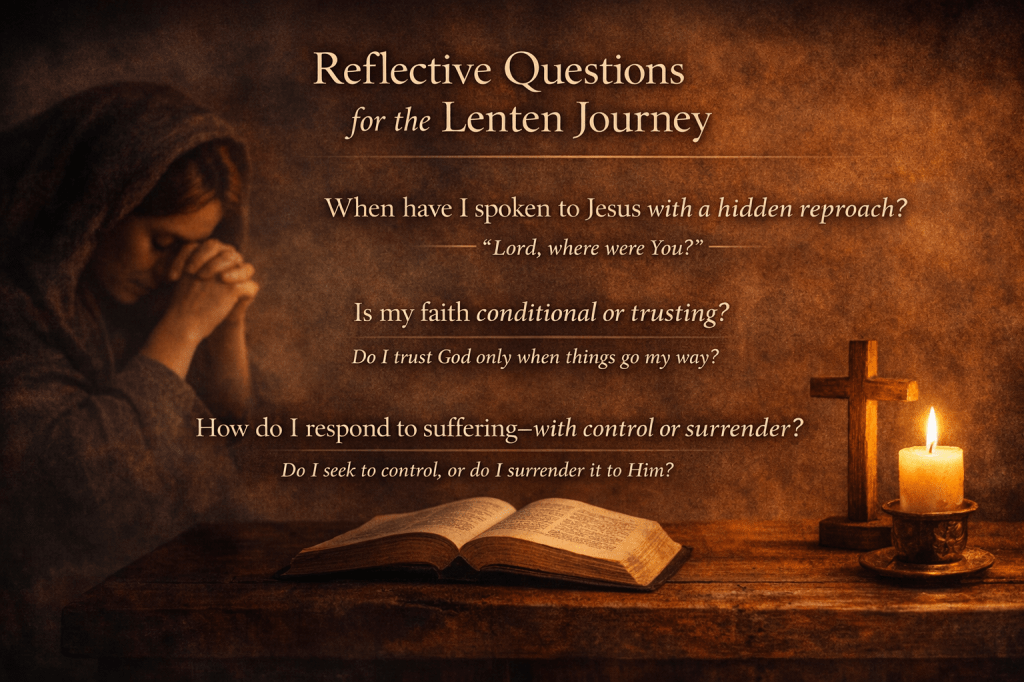
Reflective questions:
- When have I spoken to Jesus Christ with a hidden “reproach”?
In moments of disappointment or suffering, do my prayers subtly say, “Lord, where were You?” What does this reveal about the limits I place on God? - Is my faith conditional or trusting?
Do I only feel secure in God’s presence when things go according to my expectations, or can I still trust Him when outcomes are unclear, delayed, or painful? - How do I respond to suffering, with control or surrender?
When faced with difficulties, do I try to control the situation and blame God when it fails, or do I consciously entrust that moment to Him, believing He is present and at work even in silence?
With love,
Little-pencil
 Little-pencil