

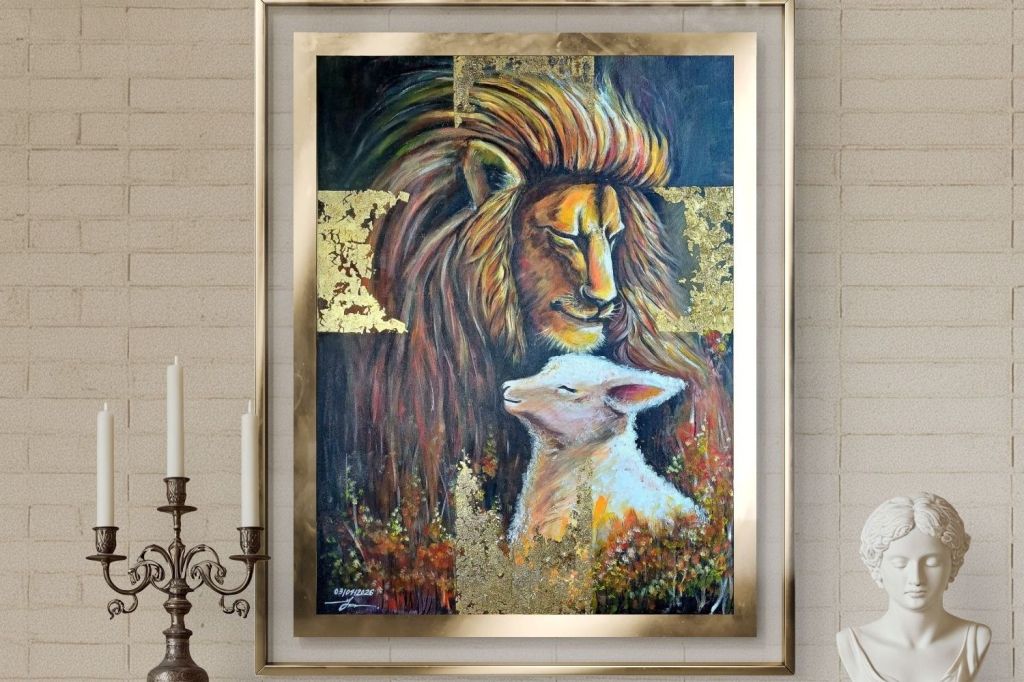
The paradox of Jesus Christ as both “Mighty Lion” and “Sacrificial Lamb of God” is one of the richest biblical images revealing the fullness of His identity and mission. These two seemingly opposite symbols, power and vulnerability, judgment and mercy, are not contradictory, but profoundly united in Him.
Let’s discover together:
1. Christ the Lion: Power, Kingship, and Victory
The image of the Lion comes from many biblical verses:
- Book of Genesis 49:9–10, where Judah is described as a lion, symbolizing strength and kingship
“Judah is a lion’s whelp,
from the prey, my son, you have gone up.
He crouches down, he stretches out like a lion,
like a lioness—who dares rouse him up.”
In our journey of faith, we come across the majestic figure of the Lion of Judah, representing Christ’s powerful nature. The lion signifies His strength and authority.
- Hosea’s Image: Divine Power and Judgment
“They shall go after the Lord; He will roar like a lion…” (Hosea 11:10)
The Lord’s “roar” symbolizes authority and irresistible call, fulfilled in Christ’s divine voice.
“For I will be like a lion to Ephraim…” (Hosea 5:14)
This verse shows divine judgment; an aspect also associated with Christ as judge. - Micah (Remnant with Lion-like Authority)
“The remnant of Jacob shall be among the nations… like a lion among the beasts…” (Micah 5:8)
In a Messianic context (Micah 5 also foretells Bethlehem), this reflects the power flowing from the Messiah’s reign. - Isaiah 31:4
“This is what the Lord says to me: “As a lion growls, a great lion over its prey—and though a whole band of shepherds is called together against it, it is not frightened by their shouts or disturbed by their clamor, so the Lord Almighty will come down to do battle on Mount Zion and on its heights.” – Isaiah 31:4 - Proverbs 28:1
“The wicked flee though no one pursues, but the righteous are as bold as a lion.” – Proverbs 28:1 - In the Book of Revelation: The image of the Lion comes most explicitly from the verse:
– “Behold, the Lion of the tribe of Judah, the Root of David, has conquered…” (Revelation 5:5)
This title connects Jesus to the royal lineage of King David and the prophecy
As Lion, Christ:
– Conquers sin and death (cf. 1 Corinthians 15:55–57)
““Death has been swallowed up in victory.”
Where, O death, is your victory?
Where, O death, is your sting?”
The sting of death is sin, and the power of sin is the law.
But thanks be to God, who gives us the victory through our Lord Jesus Christ.”
– Exercises divine authority (cf. Matthew 28:18)
And Jesus came and said to them, “All authority in heaven and on earth has been given to me.
– Judges the nations (cf. Revelation 19:16)
“On his robe and on his thigh, he has a name inscribed, “King of kings and Lord of lords.””
Thus, the Lion image speaks of majesty, sovereignty, and victorious power Christ as King.
2. Christ the Lamb: Sacrifice, Humility, and Redemption
Yet when John turns to see this Lion, he beholds something unexpected:
– “I saw a Lamb standing, as though it had been slain…” (Revelation 5:6)
This Lamb imagery echoes Book of Isaiah:
– “Like a lamb that is led to the slaughter…” (Isaiah 53:7)
And is fulfilled in the proclamation of John the Baptist:
– “Behold, the Lamb of God, who takes away the sin of the world!” (John 1:29)
As Lamb, Christ:
– Offers Himself as a sacrifice for sin (cf. Hebrews 9:26 and Acts 8:32)
“The eunuch was reading this passage of Scripture: “He was led like a sheep to the slaughter, and as a lamb before its shearers is silent, so he did not open his mouth.” – Acts 8:32
– Embodies meekness and obedience (cf. Philippians 2:8)
– Brings redemption through His blood
“But with the precious blood of Christ, a lamb without blemish or defect.” – 1 Peter 1:19
“For the Lamb at the center of the throne will be their shepherd; he will lead them to springs of living water. And God will wipe away every tear from their eyes.” – Revelation 7:17
The Lamb reveals self-giving love, humility, and redemptive suffering.
3. The Unity of Lion and Lamb
The profound theological insight lies here:
– The Lion conquers precisely by becoming the Lamb.
Jesus does not defeat evil through brute force, but through sacrificial love. The victory of Christ is not a denial of suffering, but its transformation.
– At the Cross, the Lamb appears weak but this is the very moment of divine triumph (cf. Gospel of John 19:30, “It is finished”).
– In the Resurrection, the Lion’s victory is revealed but it is inseparable from the wounds of the Lamb.
Thus, power in Christ is redefined: Not domination, but self-emptying love.
4. Practical Lessons for Christians
4.1. Embrace both strength and humility
Christians are called not only to be courageous (like the Lion), but also gentle and sacrificial (like the Lamb). True holiness holds both together. “This balance reminds us that we can be strong in the face of adversity without losing our gentleness and compassion. Combining the fierce protection represented by the lion with the peaceful nature of the lamb in our daily lives can lead to meaningful interactions and stronger relationships.” (Retrieved from biblestudyforyou.com)
“The wolf will live with the lamb, the leopard will lie down with the goat, the calf and the lion and the yearling together; and a little child will lead them.” – Isaiah 11:6
“If it is possible, as far as it depends on you, live at peace with everyone.” – Romans 12:18
“I can do all this through him who gives me strength.” – Philippians 4:13
“Take my yoke upon you and learn from me, for I am gentle and humble in heart, and you will find rest for your souls.” – Matthew 11:29
4.2. Victory comes through sacrifice
In a world that seeks power through control, Christ teaches that real victory often comes through surrender, forgiveness, and love.
“I can do all this through him who gives me strength.” – Philippians 4:13
“Be completely humble and gentle; be patient, bearing with one another in love.” – Ephesians 4:2
4.3. Trust God in apparent weakness
Moments of suffering, failure, or silence are not meaningless. In Christ, they can become places of grace and transformation.
“But he said to me, “My grace is sufficient for you, for my power is made perfect in weakness.” Therefore I will boast all the more gladly about my weaknesses, so that Christ’s power may rest on me.” – 2 Corinthians 12:9
4.4. Live a redemptive life
Like the Lamb, Christians are invited to offer their lives for others through service, patience, and charity.
“Blessed are the peacemakers, for they will be called children of God.” – Matthew 5:9
“And to put on the new self, created to be like God in true righteousness and holiness.” – Ephesians 4:24
4.5. Trusting God’s plan
“The imagery of the lion and the lamb serves as a gentle reminder for us to trust God’s plan for our lives. Just as the lion and lamb coexist in a seemingly contradictory partnership, God has a divine purpose for every aspect of our lives—interweaving our strengths and weaknesses to fulfill His will. In trusting His plan, we find peace, knowing that He understands the complexities of our hearts and is always working for our good. Each moment of our lives is part of a greater design, and when we surrender to it, we can find rest in His assurance, allowing our faith to flourish.” (Retrieved from biblestudyforyou.com)
“Trust in the Lord with all your heart and lean not on your own understanding.” – Proverbs 3:5
“For I know the plans I have for you,” declares the Lord, “plans to prosper you and not to harm you, plans to give you hope and a future.” – Jeremiah 29:11
“Commit your way to the Lord; trust in him and he will do this.” – Psalms 37:5
“And we know that in all things God works for the good of those who love him, who have been called according to his purpose.” – Romans 8:28
Conclusion
Jesus Christ as Lion and Lamb reveals a divine paradox:
He reigns by loving, and He conquers by giving Himself.
To follow Him is to enter this mystery
to become strong in faith, yet gentle in love,
to face the world with courage yet carry the Cross with trust.
Let us pray:
Lord Jesus Christ,
You are the Lion.: strong, victorious, and full of majesty.
You are the Lamb: gentle, silent, and given for love.
I come before You, often confused by my own weakness.
I want to be strong, to overcome, to stand firm yet I resist sacrifice, I avoid the Cross, I hesitate to give myself fully.
But You reveal a deeper truth:
that true victory is not found in power alone, but in love that is willing to be broken.
You, the Lion of Judah, did not conquer by force, but by becoming the Lamb who was slain.
On the Cross, what seemed like defeat
became the greatest triumph of love.
Teach me, Lord, this mystery.
When I am strong, keep me humble.
When I am weak, make me trust.
When I am wounded, help me to love instead of withdraw.
Give me the courage of the Lion
to stand for truth, to persevere in faith,
to not be afraid of the darkness around me.
And give me the heart of the Lamb
to forgive when it is difficult,
to serve without seeking reward,
to offer myself in quiet love.
Lord Jesus,
in my daily life,
in my work, my relationships, my hidden struggles,
help me to live this union of strength and sacrifice.
May I not seek victory without love,
nor embrace suffering without hope.
Let my life, like Yours,
become a gift for others.
You who reign as the Lion,
and save as the Lamb,
transform my heart.
Amen.
With love,
Little-pencil’s research and reflection
 Little-pencil
🙏🙏😀
LikeLike