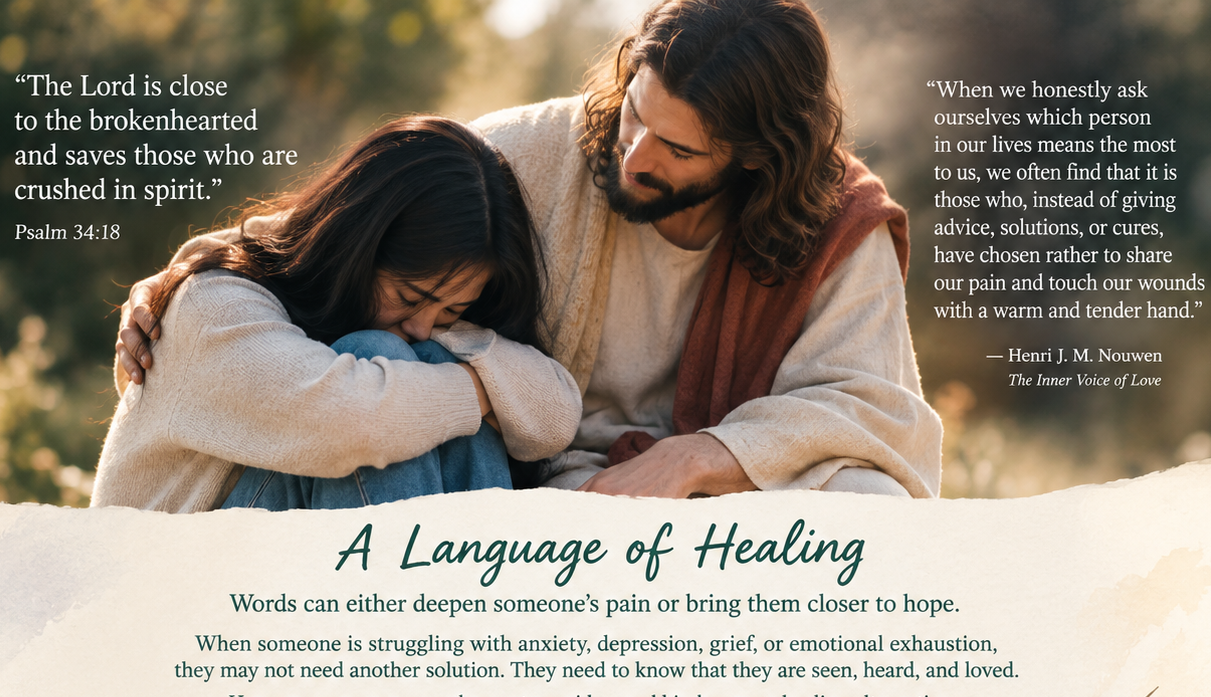
Words are never just words. They can become a shelter for a wounded heart or another burden for someone who is already struggling. When a person is experiencing anxiety, depression, grief, or emotional exhaustion, even a well-intentioned sentence can either open a door to healing or make them feel more alone.
Often, we are quick to give advice because we genuinely want to help. We say, “Don’t worry,” “Be strong,” or “You need to think positively.” But sometimes, the person in front of us does not need another solution. They need to know that someone sees their pain, hears their story, and is willing to remain beside them.
A language of healing begins with empathy. It changes our approach from “How can I fix this person?” to “How can I be present with this person?” It teaches us to listen before speaking, understand before judging, and accompany before offering solutions.
This does not mean that advice has no place. Rather, advice becomes more meaningful when it grows out of understanding and relationship. Before we try to change someone’s situation, we can first help them feel safe enough to share it.
“When we honestly ask ourselves which person in our lives means the most to us, we often find that it is those who, instead of giving advice, solutions, or cures, have chosen rather to share our pain and touch our wounds with a warm and tender hand.”
– Henri J. M. Nouwen, The Inner Voice of Love
For Christians, this language of healing can also become a language of compassion. Jesus often responded to human suffering not with condemnation, but with presence, attention, compassion, and dignity. His presence communicated a profound message: “You are seen. You are valued. You are not alone.”
“Can a mother forget the baby at her breast and have no compassion on the child she has borne? Though she may forget, I will not forget you! See, I have engraved you on the palms of my hands.”
– Isaiah 49:15–16This is especially powerful because it presents God’s love as personal, faithful, and impossible to forget. For someone experiencing anxiety, depression, loneliness, or emotional pain, the message is deeply comforting: God has not forgotten you, even when you feel forgotten.
So, how can we turn empathy into everyday words? How can we replace words that unintentionally dismiss someone’s pain with words that communicate understanding, companionship, and hope?
The following examples offer a simple starting point. They show the difference between giving advice and offering presence, between trying to make someone’s pain disappear and having the courage to sit with them in the midst of it.
A “Language of Healing”
| Instead of saying | Try saying |
|---|---|
| “Don’t overthink.” | “I know your mind is really tired right now.” |
| “Come on, stay strong!” | “Let’s take it one step at a time.” |
| “You have to be strong.” | “You don’t have to be strong on your own.” |
| “You should pray more.” | “We can pray together if you would like.” |
| “Other people have it worse.” | “Your pain is still worthy of being heard.” |
| “You’re thinking too much.” | “What is worrying you the most?” |
| “You need to cheer up.” | “I can be here with you today.” |
This is the movement from advice → presence, from simply telling someone what they should do to being truly present with them.
Sometimes, healing does not begin with the perfect answer.
Sometimes, it begins with the right words and a heart willing to stay.
With love,
Little-pencil